What is getMindmap?
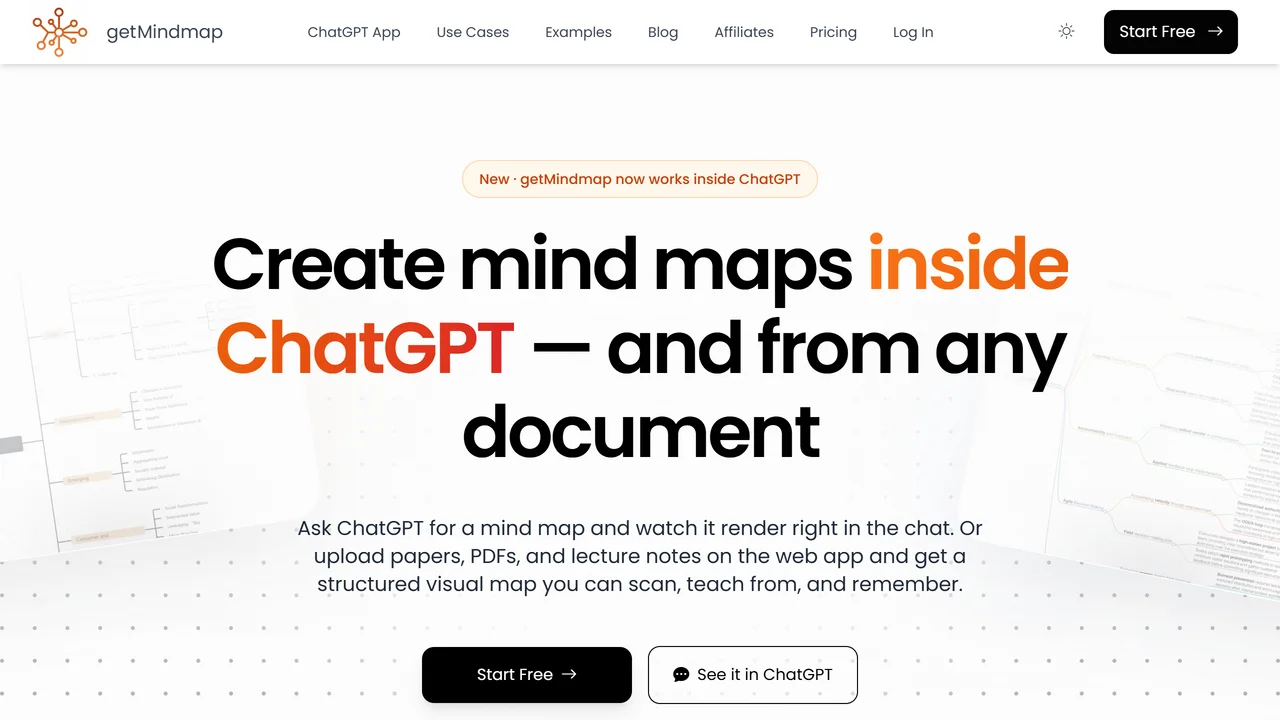
getMindmap is an AI-powered tool that transforms dense information into interactive mind maps directly inside ChatGPT or from any document. It extracts key concepts, hierarchy, and relationships from papers, PDFs, lecture notes, articles, or long passages of text, making complex material easier to understand, teach, and review.
Key features include seamless integration with ChatGPT, allowing you to create mind maps without leaving the conversation. You can zoom, fit, and resize maps right within the chat interface. The tool supports input from various sources: paste text, upload PDFs, or describe what you need in a conversation. It then generates a visual map that clarifies arguments, methods, findings, and gaps. Maps can be exported to PDF, PNG, SVG, and Markdown for sharing or further use.
Benefits include enhanced comprehension and recall, especially for learners and educators. Over 8,000 users have created more than 1,000,000 mind maps, using getMindmap for literature reviews, academic readings, lecture preparation, long articles, and self-directed learning. It is particularly strong for dense, high-stakes material where understanding relationships is critical. The tool supports ADHD-friendly learning workflows by providing a visual structure that reduces cognitive load.
Use cases span education, research, and professional development. Students can convert lectures and case studies into teaching outlines. Researchers can map literature reviews to compare sources. Professionals can turn business plans or reports into clear visual summaries. The free tier requires no credit card, making it accessible for anyone to start.
Technical details: getMindmap uses AI to analyze input text, identify main topics and subtopics, and organize them hierarchically. The algorithm detects relationships and creates a structured map that users can interact with. The integration with ChatGPT allows real-time map generation during conversations. Exports retain the map's structure and can be embedded in documents or presentations. The tool is web-based and works on any device with a browser.
Use Cases
Key Features
AI powered mind maps ChatGPT integration PDF upload support concept extraction hierarchy visualization export to PDF/PNG/SVG/Markdown zoom and resize relationship mappingWho is it for?
students, educators, researchers, content creators, lifelong learners, academic readers, self, directed learners