What is ExLlama?
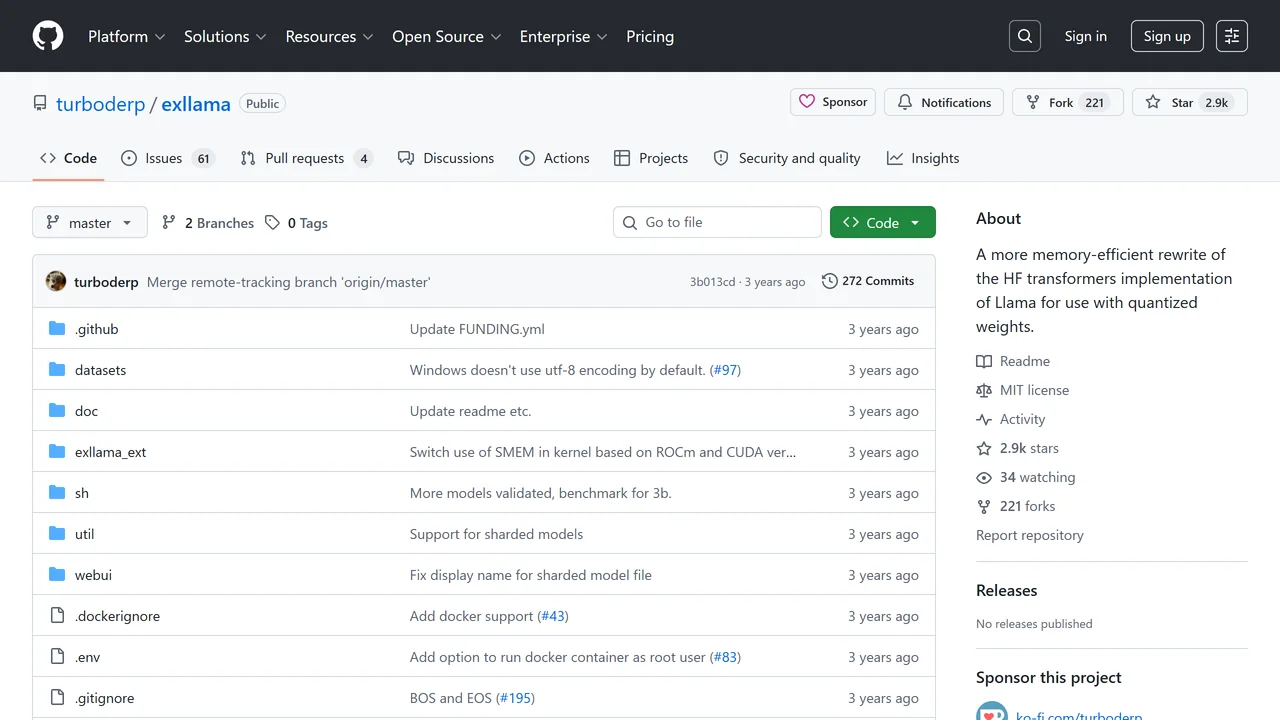
ExLlama is a standalone Python/C++/CUDA implementation of the Llama language model, specifically optimized for use with 4-bit GPTQ quantized weights. It is designed to be fast and memory-efficient on modern GPUs, making it an excellent choice for running large language models locally with reduced resource requirements. The project is actively developed by turboderp, primarily on RTX 4090 and RTX 3090-Ti GPUs, ensuring strong support for 30-series and later NVIDIA GPUs. However, older Pascal-era GPUs with poor FP16 support may not perform well; for such hardware, alternatives like AutoGPTQ or GPTQ-for-LLaMa are recommended. ROCm is theoretically supported via HIP, though no AMD devices are currently available for testing or optimization.
Key features include runtime loading of the CUDA extension, which is compiled on first use and cached to ~/.cache/torch_extensions/, eliminating the need for separate installation. This makes setup straightforward for users familiar with Python and CUDA environments. ExLlama is particularly suited for developers and researchers who need to deploy Llama models in resource-constrained settings, such as on single GPU setups or for applications requiring low latency. It can be integrated into other projects via an installable Python module maintained by jllllll, offering flexibility for custom workflows.
Use cases include running chatbots, text generation, and other NLP tasks that benefit from Llama's capabilities. A simple web UI is available for interactive use, though it is noted to have JavaScript written by ChatGPT, which may have quirks. The web UI supports multibot mode and stores sessions locally. For secure deployment, a Docker container is provided, supporting NVIDIA GPUs and recommended for rootless mode. ExLlama is ideal for those seeking a memory-efficient, high-performance Llama implementation for quantized models, with active community support and ongoing improvements.
Use Cases
Key Features
bit GPTQ quantization fast GPU inference memory efficient runtime CUDA compilation single GPU deployment Llama model support active development RTX 30 series optimizedWho is it for?
AI researchers, machine learning engineers, NLP developers, GPU computing specialists, hobbyists running local LLMs, Python developers