
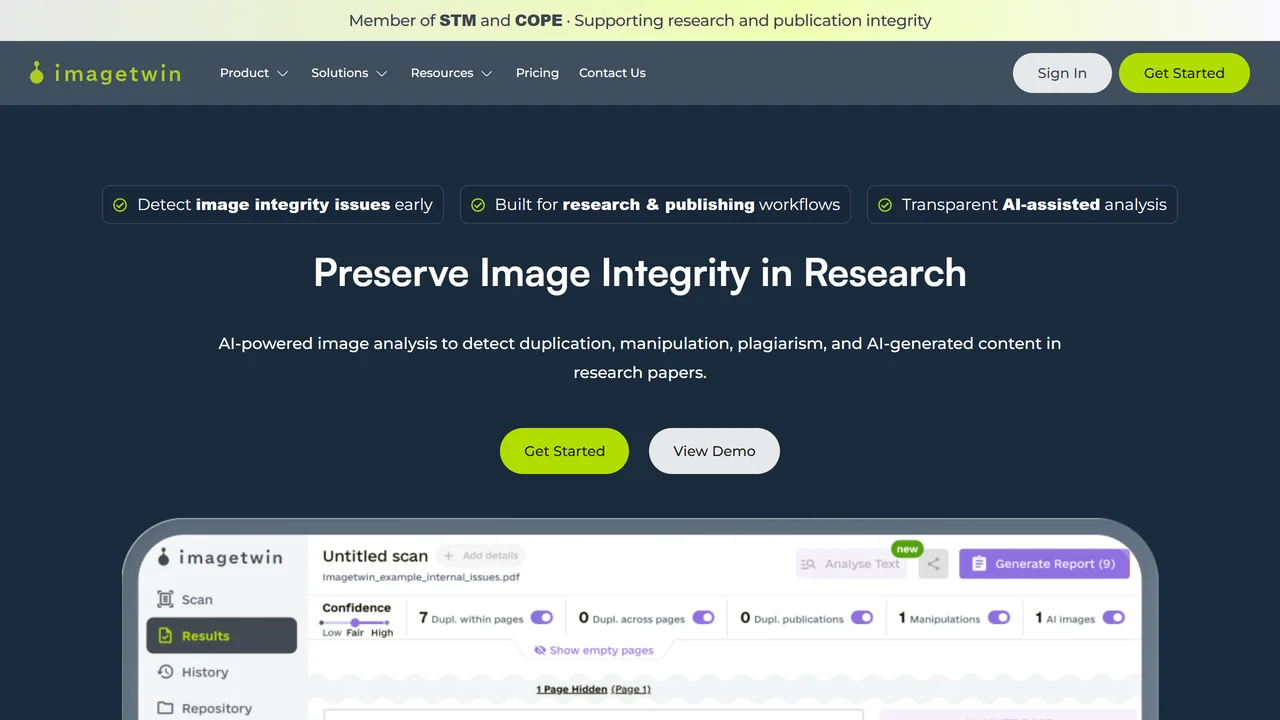
What is ImageTwin?
ImageTwin leverages cutting-edge artificial intelligence to scrutinize scientific images for signs of manipulation or duplication. It specializes in detecting common forms of image tampering, such as splicing (where parts of different images are combined), duplication (repeating regions within the same image), and removal of artifacts. The tool can analyze images from PDFs or direct uploads, comparing them against a vast database of previously published figures to identify potential duplicate publications or stolen images. Its user-friendly interface allows researchers, editors, and reviewers to quickly assess the integrity of figures before publication. ImageTwin also provides detailed reports highlighting suspicious areas, enabling informed decisions. By automating the detection process, it saves time and reduces human bias in image screening. As scientific publishing faces increasing scrutiny over reproducibility, ImageTwin offers a robust solution to uphold ethical standards. Its algorithms are continually trained on diverse datasets to improve accuracy against evolving manipulation techniques. Whether for pre-print screening or post-publication audits, ImageTwin is a vital tool for maintaining trust in scientific research.
Use Cases
Key Features
AI-powered image manipulation detection Duplicate image identification across databases Splice and region duplication analysis PDF and image file support Detailed graphical reports with highlighted anomalies Continuous algorithm updates to counter new manipulation techniquesWho is it for?
Researchers, journal editors, peer reviewers, academic institutions, and scientific publishers


