What is Cambrian?
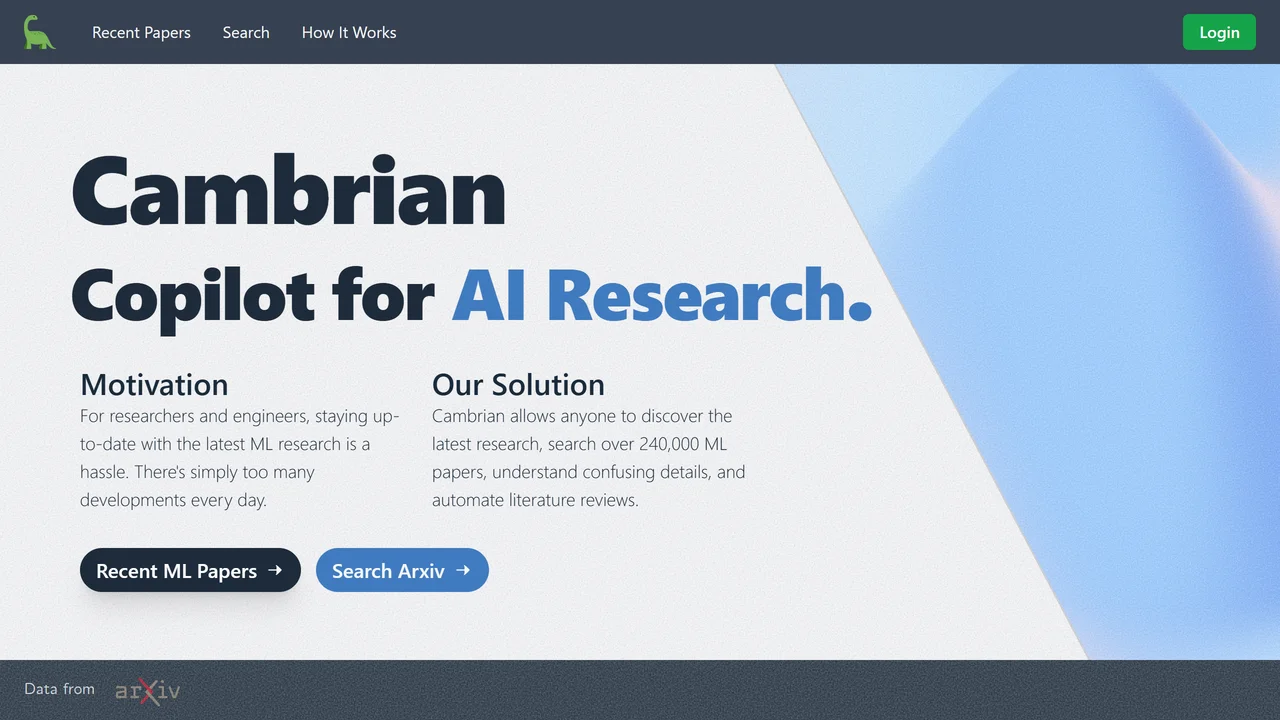
Cambrian is a powerful tool designed for researchers and engineers to effortlessly navigate the ever-expanding landscape of machine learning research. With over 240,000 ML papers indexed, Cambrian provides a comprehensive search engine that allows users to discover the latest developments, dive into specific topics, and stay current with daily advancements. The platform addresses the common pain point of information overload by offering intelligent search capabilities that go beyond simple keyword matching. Users can search by author, conference, year, or specific technical concepts, making it easy to find relevant papers even when they are not sure of the exact terminology.
One of Cambrian’s standout features is its ability to help users understand confusing details in research papers. Through AI-powered explanations and contextual summaries, it breaks down complex methodologies, equations, and results into digestible insights. This is particularly valuable for those new to a field or for interdisciplinary researchers who need to quickly grasp the essence of a paper without reading it in full. Additionally, Cambrian automates literature reviews by generating structured overviews of a research area, highlighting key papers, trends, and gaps. This saves countless hours that would otherwise be spent manually curating and synthesizing information.
For use cases, Cambrian is ideal for PhD students conducting thesis research, industry researchers monitoring competitors, and engineers implementing state-of-the-art models. It also supports collaborative features, allowing teams to share collections of papers and annotations. Technically, Cambrian uses advanced natural language processing and machine learning to index and retrieve papers, ensuring high accuracy and relevance. The platform is continuously updated with new papers from arXiv, conference proceedings, and other sources, so users always have access to the latest work. By streamlining the discovery and comprehension of ML research, Cambrian empowers users to focus more on innovation and less on administrative overhead.
Use Cases
Key Features
k+ ML papers indexed intelligent search beyond keywords AI powered explanations contextual summaries automated literature reviews search by author/conference/year breaks down complex methodologiesWho is it for?
ML researchers, AI engineers, data scientists, interdisciplinary researchers, students, academics